Tuesday, January 15, 2008

The Resort at al-Oga Nsru'n

Is Dubai officially creepy yet? At some point, after yet another resort, skyscraper, and man-made island, it morphed from Vegas-by-the-Sea into the city from Logan’s Run.

You tell me which is which.

Tuesday, January 1, 2008

Red States, Blue States, Dream States (Part 1)

According to recent studies, sleep occurs in one of two ways, each of which is distinct and visible on EEG and other brain scans. I call these states “inner-directed” and “outer-directed” sleep, but these are my terms only. I will explain why I use them shortly.

Innies and Outies

Babies choose or learn a preferred, predominant way to sleep before they are one year old. This preferred method continues throughout life, but the preference isn’t set in stone. An inner-directed sleeper can become outer-directed for a night, and vice versa, depending on a range of factors (psychological changes, stress, or even diet).

Most sleepers are inner-directed. It’s the physical equivalent of idling a motor for eight hours, or setting a computer on sleep or hibernate. Brain activity during inner-directed sleep occurs in the same regions as it does during consciousness, although over a smaller area and with less fluctuation in intensity from minute to minute.

Outer-directed sleep is where things get interesting. In this case, brain activity is as intense as during consciousness, but focused almost exclusively in the emotional and pleasure centers. Outer-directed sleepers report feeling more rested when awaking, compared with inner-directed sleepers. They also have better recall of their dreams, which are more vivid than those reported by their counterparts.

Studies place the ratio of inner and outer-directed sleepers at approximately 750 to 1. Outer-directed sleepers are self-reportedly more empathetic and intuitive. Statistically, they are disproportionately represented in the arts and healing sciences.

Messages from the Dark Side

If there is a collective unconscious, as Jung proposed, it would manifest itself most readily in a state where the defenses and distractions of sensory stimulation and the ego are subordinated. This might include mystical states, drug-induced visions, and stress or trauma-related experiences.

However, the collective unconscious is available to most everyone through the dream state. I don’t suggest that every dream is laden with archetypes and links to the collective unconscious. But sometimes a dream is a window into something we feel as a clan, group, or society that we can’t quite put our finger on yet.

I believe those people who achieve outer-directed sleep (for wtap into the collective unconscious more readily. Anything available in the collective unconscious would reach these people more easily and more directly.

Given the statistic cited early, you might think that only one in 750 people could tap into the collective unconscious. That statistic, however, is compiled from sleep studies that examined only short stretches of sleep (no more than a few nights). I think it’s more accurate to say that outer-directed sleep is likely to occur once every 750 sleep-nights across a broad population.

That is, while some might never achieve outer-directed sleep (and a lucky few might experience it nightly), on average a person would awake feeling deeply rested and pondering a vivid, deeply felt dream approximately once every couple of years.

Does this sound like your experience? It sure sounds like mine.

Dreaming of 2008

The Iowa primary is two days away. If you recall the title of this post, you might be wondering what any of this has to do with the election. I’ll expand on that in Part 2.

Tuesday, December 18, 2007

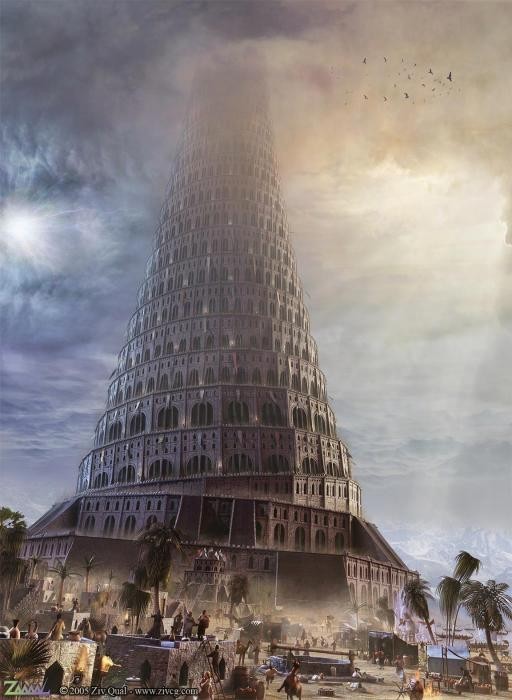
The Tower of Babel Was a Controlled Demolition

Who said the following?

“If they are able to accomplish all this when they have just begun to exploit their linguistic and political unity, just think of what they will do later. Nothing will be unattainable for them!”

I realize he sounds like a poorly scripted tyrant in a videogame, but it’s the standard translation I have. Any guesses? How about if I feed you the next line of dialog?

“Let us go down and give them different languages so they won’t understand each other’s words.”

Yep, it’s the big guy, the man upstairs, the Fonz, Ronald McDonald. You know, G-O-D.


It’s from Genesis 11:6-7, one of the most perplexing passages in the Bible, and for that reason, also one of the most interpreted.

The boss man of the Old Testament shows a lot of emotion, usually a violent temper followed by a pang of regret. And the ancients acted like a battered spouse, always ready to forgive and forget.

But the Tower of Babel story is the only story I know where God acts a little scared, as if his battered victims are finally going to leave him.

Maybe the tower was a way out. Perhaps a spaceship, as the Raelians and others believe, or some kind of portal technology. Of course, that would make the god (or gods) of the Old Testament extraterrestrials. But who could believe that?

On that note: Happy Holidays!

Sunday, December 16, 2007

Sunday, December 9, 2007

Notes From Utah

Thinking about Romney's speech on Mormonism, I dug through my files and found these notes, taken during a week in Provo about a decade ago. The only things I read that week were the Book of Mormon in the hotel room and the local paper.

"His hands were naked, and his arms also, a little above the wrists; so, also, were his feet naked, as were his legs, a little above the ankles. His head and neck were also bare. I could discover that he had no other clothing on but this robe, as it was open, so that I could see into his bosom."

Joseph Smith, "The Pearl of Great Price," 9/21/1823

"The East High gay and lesbian club proposal is like a camel's initial proposal to put his nose into the 'tent'' of Utah schools. The ultimate goal is to infiltrate all Utah schools, forcing traditional moral values to die out as the rising generation pities, endures, then embraces their lifestyle."

The Deseret News, Readers' Forum Editorial, 2/27/1996

Saturday, December 8, 2007

42*

Maybe Jim Carrey was onto something with the number 23, but I keep tripping over "42" lately.

Last week I finished “The Hitchhiker’s Guide to the Galaxy,” where the answer to the riddle of life, the universe, and everything is--as any fan knows--“42.” Douglas Adams said he needed an “ordinary, smallish number” to suit his punchline.


While working on my taxes this morning, I stumbled across the IRS’ life expectancy tables. Turns out that age 42 is the first year where life expectancy is shorter than years already lived.

And with that, the gears started turning and the mindwig started feeding, courtesy of the Internet.

According to Wikipedia, 42 is considered an unlucky age in Japan because 4 (shi) and 2 (ni) are together pronounced like “going to death.” A nice metaphor for middle age.

There’s even a festival in Japan where drunken 42-year-old men carry a phallus-shaped cypress tree for a mile. The procession is supposed to help them spiritually evolve through a particularly rough year--unless they’re not crushed under a half-ton cypress trunk, I suppose.

In ASCII, “42” is the asterisk glyph, which represents a placeholder. Another apt metaphor for middle age. You’re not dead yet, but they’re saving a place.

I will crawl into bed and cry myself to sleep now.

*Forgive the obsession, but I just turned 42.